
USA & World
If AI Takes Our Jobs, Who Will Have Money to Buy Anything?
Companies are investing billions into AI that can replace human workers. But if millions of people lose their incomes, who will be left to buy what those companies produce?
By Dwight Simpson
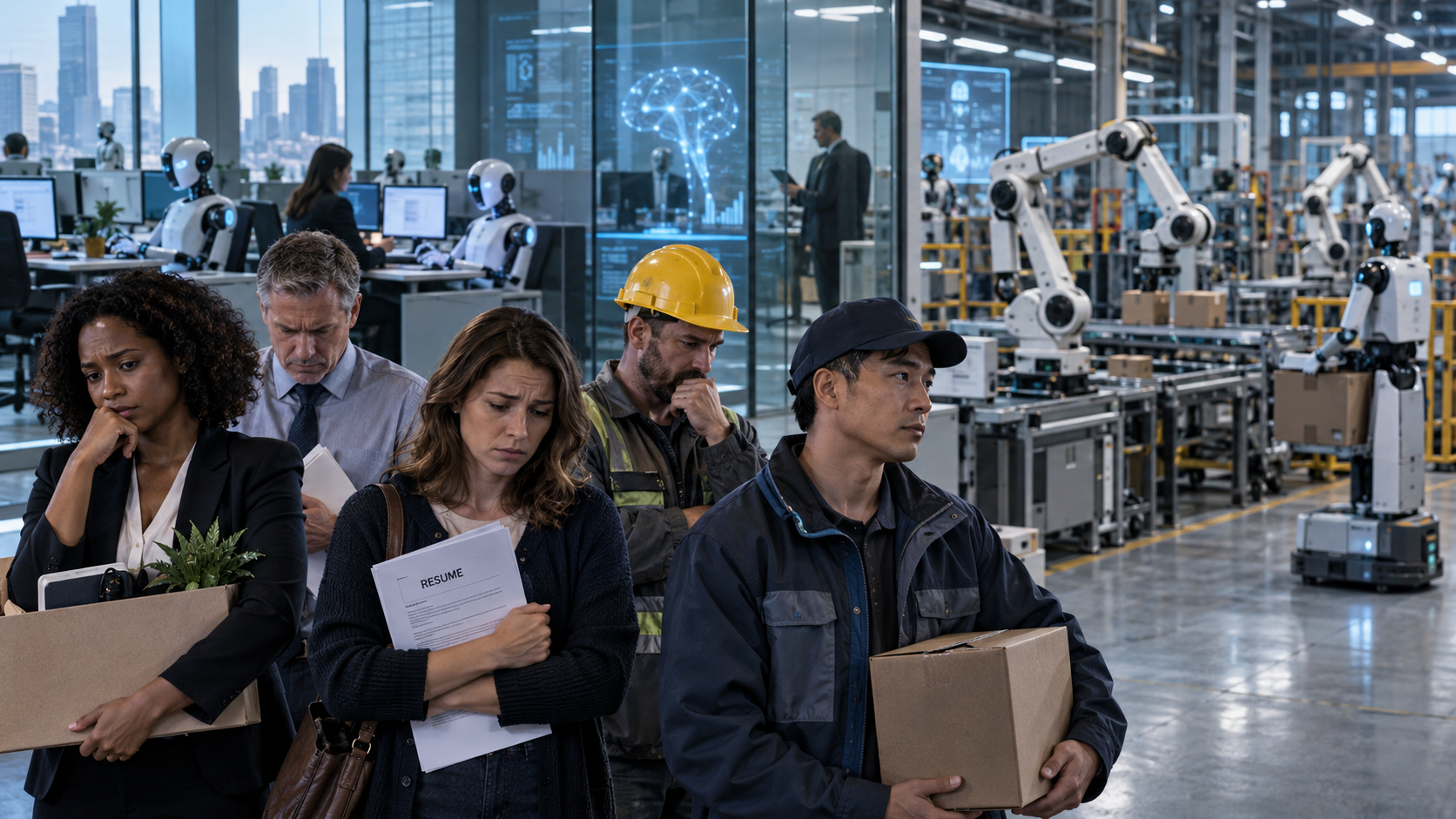
Artificial intelligence is being sold as the next great productivity revolution.
Companies are investing billions of dollars into AI systems that can write, calculate, design, analyze, communicate, program and perform work that once required human employees.
But there is a question that receives far less attention:
If AI eventually takes a large percentage of human jobs, who will still have enough money to buy what companies are producing?
That question could become one of the defining economic challenges of the AI era.
Businesses Want Efficiency — But Workers Are Also Customers
For individual companies, replacing human labour with automation can appear financially attractive.
If an AI system can perform work previously handled by 20 employees, a company could potentially reduce wages, benefits, office costs and other expenses.
But what makes sense for one company could become a serious problem if thousands of businesses do the same thing.
Workers are not just employees.
They are also consumers.
Their wages pay for mortgages, rent, groceries, vehicles, clothing, restaurants, vacations, entertainment, insurance and countless other products and services.
If millions of workers lose their income, businesses could eventually discover that they have become extremely efficient at producing goods for customers who can no longer afford them.
What Happens If Unemployment Becomes Structural?
Economies have experienced technological disruption before.
Factories replaced some manual labour. Computers transformed offices. The internet eliminated some industries while creating entirely new ones.
AI could be different because it has the potential to affect both physical and intellectual work.
Administrative employees, programmers, writers, designers, accountants, customer-service representatives, analysts and many other professionals could see substantial portions of their jobs automated.
Robotics could eventually expand that disruption further into transportation, warehousing, manufacturing and other physical industries.
The concern is not simply that people could lose jobs temporarily.
The larger question is whether economies could reach a point where there are permanently fewer human jobs than people seeking employment.
AI Could Create Enormous Wealth
There is another side to this story.
AI could make society dramatically more productive.
Businesses may be able to produce more goods and services with fewer resources.
Medical research could accelerate.
Transportation could become safer.
Dangerous industrial jobs could be automated.
Businesses could operate more efficiently.
New industries that do not currently exist could emerge.
In theory, technological progress could make society considerably wealthier.
But greater wealth does not automatically mean that everyone becomes wealthier.
The central issue may become who owns the technology and who receives the economic benefits it produces.
What If a Few Companies Own Most of the AI?
Imagine an economy where a relatively small number of corporations control the most powerful AI systems, data centres, robots and automated infrastructure.
Those companies could generate enormous profits while employing far fewer people than today's major corporations.
That could result in unprecedented concentrations of wealth.
Instead of thousands of workers receiving salaries, a much larger share of corporate revenue could flow to shareholders and technology owners.
Without changes to economic policy, AI could therefore increase the divide between people who own productive technology and people who depend on wages.
Governments Could Lose Tax Revenue
There is also a government problem.
Governments collect enormous amounts of revenue from employment.
Workers pay income taxes.
Employers make payroll contributions.
Employment generates consumer spending, which produces additional tax revenue.
If large numbers of workers disappear from payrolls, governments could face declining revenue at exactly the same time they are being asked to provide more unemployment assistance and social services.
That could force governments to completely reconsider the tax system.
Could Governments Tax AI?
One controversial possibility is an automation or so-called robot tax.
Instead of collecting taxes primarily from human labour, governments could require highly automated companies to contribute more based on the economic value created by their technology.
Supporters argue that if automation replaces large numbers of taxpayers, some of the revenue generated by machines may eventually need to replace the taxes previously collected from workers.
Businesses and critics could argue that such taxes would punish innovation and make countries less competitive.
Finding the balance would not be simple.
Universal Basic Income Could Move From Theory to Necessity
Universal Basic Income has been debated for years.
Under a UBI system, people receive a regular guaranteed income regardless of whether they are working.
Today it remains a controversial political and economic idea.
In a future where AI eliminates a substantial percentage of available jobs, however, governments could face pressure to reconsider it.
If companies no longer need millions of workers but still need millions of customers, governments may ultimately need some mechanism that allows people to continue participating in the economy.
That could involve basic income, expanded tax credits, public housing, subsidized transportation or other forms of guaranteed support.
Maybe Humans Will Simply Work Less
Mass unemployment is not the only possible outcome.
AI could instead create a world where people work fewer hours.
If one employee using advanced AI can produce what previously required three employees, societies could decide to share that productivity rather than eliminate positions.
The five-day workweek could eventually shrink.
People might work four days, three days or fewer while maintaining similar levels of production.
That would require a major shift in how businesses think about productivity and wages.
The technology itself will not decide whether workers receive more free time or unemployment notices.
People and governments will.
Education Could Face a Major Reality Check
AI also raises uncomfortable questions for schools, colleges and universities.
Students can spend years training for careers that may be transformed before they retire.
Educational institutions may therefore need to focus less on memorizing information and more on adaptability, critical thinking, communication, leadership and hands-on skills.
People may also have to retrain several times during their working lives.
The idea of studying once, entering one career and remaining there for 30 or 40 years could become increasingly outdated.
Some Human Jobs May Become More Valuable
Not every profession will disappear.
In fact, certain human qualities could become more valuable as AI spreads.
People may place greater value on workers they can trust.
Healthcare, skilled trades, emergency services, education, leadership, counselling and many forms of creative work may continue to rely heavily on human judgment and relationships.
Even in journalism, AI can assist with research and production, but accountability, interviewing, source-building and public trust still depend heavily on people.
The future may not be humans versus machines.
It may be humans working alongside machines — with far fewer people required to produce the same amount of economic output.
The Question Governments Should Be Asking Now
The biggest danger may be waiting until millions of jobs disappear before preparing for the consequences.
Governments should already be considering what happens to taxation, education, pensions, employment insurance and social programs if AI significantly reduces demand for workers.
Businesses should also consider the larger economic picture.
A company may save money by eliminating employees.
But an economy cannot function indefinitely if companies eliminate the income of the same people they expect to become customers.
AI could eventually allow humanity to produce more wealth with less human labour than at any time in history.
That could create a future with shorter workweeks, greater prosperity and more freedom.
Or it could create a future where a small number of technology owners accumulate enormous wealth while millions of people struggle to find meaningful employment.
The technology may be revolutionary.
But the most important question is not whether artificial intelligence can replace human workers.
It is this:
If AI does the majority of the work, who gets the money?
And if millions of people are no longer earning regular wages —
who will be left to buy everything AI produces?
Source & attribution
Reporting by CanJam News. Information in this article is based on publicly available statements and verified reporting available at publication.
Topics

