
Online Loan Companies Remain Silent After CanJam News Questions
CanJam News contacted Dolli.ca, UnityLoans.ca, EasyCap.ca and A1Cash.ca with questions about licensing, operations and consumer protections. As of publication, none had responded.
Dwight Simpson
Founder & Editor, CanJam News
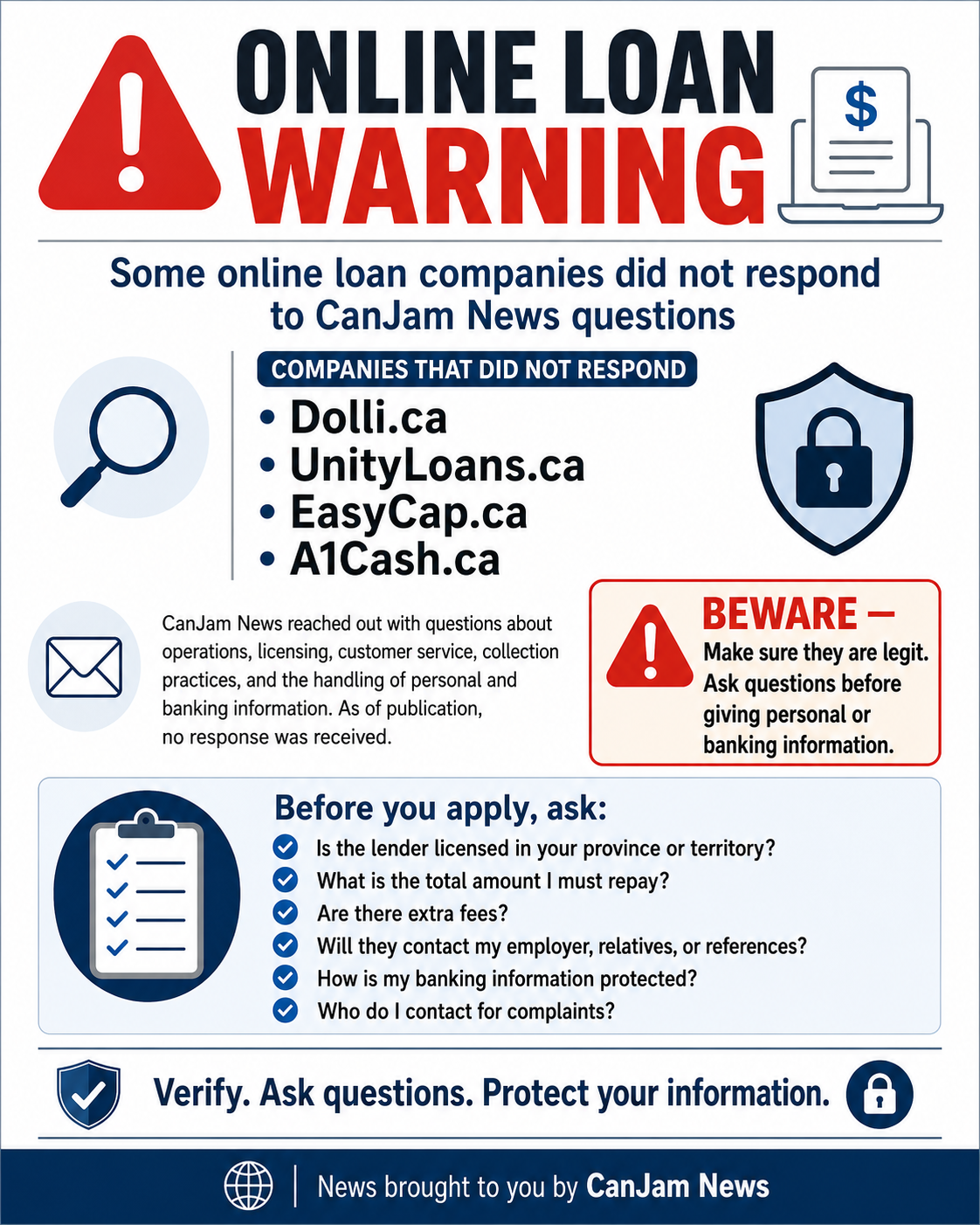
CanJam News contacted several online loan companies seeking answers about their operations, licensing, customer-service practices, collection procedures and handling of consumers' personal and banking information.
The companies contacted included Dolli.ca, UnityLoans.ca, EasyCap.ca and A1Cash.ca. As of publication, none of the companies had responded to the questions submitted by CanJam News.
"A lack of response does not, by itself, prove that a company is operating illegally. However, when a business asks consumers to provide banking information, employment details, income records and other sensitive personal information, it should be willing to answer reasonable questions."
— Dwight Simpson, CanJam News
Online Loan Offers
Online lenders commonly advertise short-term loans and ask applicants to provide personal, employment and financial information. Some online lenders may also ask applicants to connect their bank accounts electronically for income verification. Consumers should understand exactly what information the lender or any third-party service will be able to access before agreeing.
Consumers should also determine whether any additional application, brokerage, membership, referral or cosigner fees will be charged separately from the loan's advertised interest rate.
Questions That Remain Unanswered
CanJam News sought answers to several important questions: What is the company's complete legal and registered business name? Who owns and manages the company? Where is the company physically located? In which Canadian provinces and territories is it licensed or authorized to provide loans? What licence or registration numbers apply to its online operations? How is consumers' banking information collected, stored and protected? Does the company contact borrowers' employers, relatives or references when a payment is missed? Which collection company is used for overdue accounts? Are consumers required to pay separate cosigner or third-party fees? What is the company's complaint and dispute-resolution process?
These are reasonable questions for any company handling consumers' money, banking details and confidential personal information.
Consumers Across Canada Must Check Licensing
Rules governing payday loans, high-cost credit and online lending may differ between Canadian provinces and territories. Before borrowing, consumers should contact the appropriate financial or consumer-protection regulator in their province or territory to confirm whether the lender is licensed or authorized to operate there.
A professional-looking website, online advertisement or social-media page does not automatically prove that a lender is legitimate or properly licensed. Consumers should independently verify the lender's complete legal business name, its physical Canadian address, its working telephone number, its provincial or territorial licence number, the name of the regulator responsible for overseeing it, the total borrowing cost, the complete repayment schedule, and all additional fees and penalties.
Beware Before Applying
Consumers should be extremely careful before applying for an online loan. Make sure the lender is legitimate and ask questions before providing any personal or banking information. Ask the lender: What is the complete amount I will repay? What is the annual percentage rate? Are there application, membership, brokerage, referral or cosigner fees? Will I be asked to send money before receiving the loan? Who will have access to my bank account? What banking information will be collected? How long will my financial information be stored? Can I revoke access to my banking information? Will my employer, relatives or references be contacted? What happens if I miss one payment? Are payments reported to a credit bureau? How can I cancel the agreement? Who can I contact if I have a complaint?
Read the entire contract before accepting the loan. Do not feel pressured to sign immediately. Save copies and screenshots of the lender's advertisements, the website, the loan agreement, emails and text messages, the payment schedule, banking withdrawals, and conversations with customer-service representatives.
"Never send an upfront payment, gift card, cryptocurrency transfer or so-called security deposit to receive a loan."
— CanJam News Consumer Warning
Silence Raises Transparency Concerns
Online lenders may promise fast approval and quick access to money, but speed should never replace transparency, accountability and consumer protection. When companies ask consumers to trust them with banking records and personal information, consumers deserve clear answers about who operates the business, where it is located, which regulator oversees it and what protections exist when something goes wrong.
CanJam News is not declaring that Dolli.ca, UnityLoans.ca, EasyCap.ca or A1Cash.ca is fraudulent or operating unlawfully. The concern is that these companies were given an opportunity to answer questions and provide clarification, but none had responded by the time this report was published. Should any of the companies provide a response, CanJam News will review the information and update the report fairly.
Final Consumer Warning
Beware before borrowing online. Verify that the lender is legitimate and properly licensed to operate in your province or territory. Ask questions before providing personal, employment or banking information. Read every part of the agreement and confirm the total cost of the loan. When a company refuses to provide clear answers, pressures you to act quickly or asks for money before releasing a loan, treat it as a serious warning sign.
Consumers who believe they have been treated unfairly should document everything and contact the consumer-protection or financial regulator in their province or territory. Suspected fraud should also be reported to the Canadian Anti-Fraud Centre and local police.
Dwight Simpson
Founder & Editor, CanJam News
Dwight Simpson is the founder and editor of CanJam News. He has covered Canadian federal politics for over 15 years, reporting from Parliament Hill, provincial capitals, and communities across Canada and the Caribbean. His work connects the Canadian Jamaican community with the stories that shape their world.
More from DwightComments
Leave a comment

